The Lanier Family Lineage: From Tuscany to the American South
The history of the Lanier family is a remarkable narrative of migration, adaptation, and survival that reads less like a standard genealogy and more like an epic of European and American history. Spanning nearly a millennium, the family lineage weaves through some of the most dramatic cultural, religious, and political shifts in Western civilization. The clan’s trajectory—transitioning from Italian mercantile nobles to French Huguenot artisans, evolving into a massive dynasty of English royal musicians, and ultimately transforming into prominent colonial American planters—demonstrates an incredible resilience. To follow the Lanier name is to trace the flow of power, art, and commerce from the Mediterranean Renaissance to the untamed frontiers of the New World.
1. Early Roots: Tuscany to Gascony (11th–15th Centuries)
The earliest recorded roots of the lineage trace back to northern Italy, specifically the sun-drenched hills and bustling city-states of Tuscany, during the volatile era of the Crusades. Operating under the name de la Niere, historical records and etymological clues suggest the family was deeply involved in the lucrative mercantile networks or minor noble pursuits that defined medieval Italian city-states. During this period, Italy was the crossroads of global trade, and families with resources often funded or supplied the vast armies moving toward the Holy Land. The wealth generated by these Mediterranean trade routes fostered a sophisticated culture within the family, laying a foundation of cosmopolitan awareness and mercantile savvy that would serve them well in subsequent centuries. The de la Niere family likely navigated complex political alliances and fierce economic competition, honing an adaptability that became a hallmark of the lineage.
Following the conclusion of the Crusades, the political and economic center of gravity in Europe began to shift. Seeking new opportunities and perhaps escaping the intense, bloody factionalism of Italian politics (such as the bitter and prolonged conflicts between the Guelphs and Ghibellines, which frequently resulted in exile and asset seizure for the losing side), the family migrated westward. They traversed the Alps, a formidable undertaking in the Middle Ages, and settled in the province of Gascony in southwestern France. Gascony during the late medieval period was a uniquely cosmopolitan region, heavily tied to the lucrative wine trade and frequently shifting between English and French control during the Hundred Years’ War. This constant state of geopolitical flux meant that Gascony was a place where adaptable, enterprising families could thrive outside the rigid hierarchies found elsewhere in Europe. It was here, in this dynamic economic environment, that the family established its first deep French roots, leveraging their mercantile background to integrate into the local economy. Concurrently, the surname began its linguistic transition from the Italian de la Niere to a more Gallic pronunciation, signaling their integration into French society.
2. The French Era: Rouen, Normandy (16th Century)
By the dawn of the 1500s, the family had moved north to the bustling economic powerhouse of Rouen in Normandy. Positioned strategically on the River Seine, Rouen was one of the largest, wealthiest, and most cosmopolitan maritime cities in Europe—a hub of Renaissance thought, magnificent Gothic architecture, and international commerce. The city served as a vital artery connecting the interior of France to the English Channel and the wider world, making it a magnet for skilled artisans and merchants.
Here, the surname officially evolved into the Old French lanier. Etymologically, this name carried dual occupational meanings that perfectly reflected the era: it referred either to a master in the lucrative wool trade (laine being French for wool, a cornerstone of Rouen’s economy) or to the elite sport of falconry, derived from the Lanner falcon, a bird highly prized by European nobility. Whether they were weaving the fine textiles that clothed the wealthy or training the fierce birds of prey that entertained them, the Laniers were firmly embedded in the higher echelons of Renaissance craft and leisure.
As the Renaissance gave way to the Reformation, the spiritual landscape of France fractured violently. The Laniers broke from the dominant Catholic Church and embraced the Protestant Huguenot faith, a dangerous but intellectually vibrant movement that emphasized personal piety, literacy, and a break from papal authority. This conversion was a significant risk in heavily Catholic France, but it aligned the family with a reformist, forward-thinking demographic. A key patriarch of this era, John Jerome Lanier (born c. 1499), firmly established the family’s presence in Rouen not just as religious dissenters, but as exceptionally skilled artisans and musicians. His son, Nicholas Lanier the Elder (born c. 1540), elevated the family’s status significantly. Nicholas possessed an extraordinary musical talent, mastering the flute and the cornett (a curved, leather-covered wooden instrument with a brass-style mouthpiece, notoriously difficult to play but prized for its vocal-like tone). His virtuosity earned him a highly coveted position in the royal court of King Henry II of France, establishing the family’s first major link to royal patronage and proving that exceptional talent could transcend the growing religious divide—at least temporarily.
3. The English Dynasty: Greenwich (1561–1650s)
The family’s prestige in France was soon eclipsed by mortal danger. As religious persecution against Protestants intensified in the decades leading up to the bloody French Wars of Religion, being a Huguenot—even one in the royal court—became politically and physically perilous. Recognizing the looming threat of massacres and state-sanctioned violence against Protestants, Nicholas Lanier the Elder fled Rouen in 1561. Safe passage was arranged by the Earl of Hertford, an English nobleman sympathetic to the Protestant cause, and Nicholas arrived in London, eventually settling down in St. Olave Parish. This flight was a defining moment, severing the family’s French ties but securing their survival.
In England, Nicholas found a monarch eager to build a world-class cultural court to rival those of continental Europe: Queen Elizabeth I. He quickly secured a position as a royal musician, capitalizing on the high demand for skilled continental musicians who could introduce the latest European styles. His marriage to Lucretia Bassano—a member of the famous Bassano family, a legendary, possibly crypto-Jewish dynasty of Venetian musicians and instrument makers who had also migrated to England—was a masterstroke. This alliance created a veritable monopoly on English royal music, consolidating talent and influence within a tight-knit extended family. Together, they acquired substantial property in East Greenwich and Blackheath, close to the royal Palace of Placentia, embedding themselves in the geographic heart of Tudor power.
This marked the beginning of a legendary three-generation dynasty. For nearly a century, spanning the reigns of Elizabeth I, James I, and Charles I, the Laniers were indispensable to the English crown. They were not merely performers; they composed complex polyphonic music, performed in elaborate, hugely expensive court masques designed by Inigo Jones, painted portraits, and acted as international art agents for the monarch. The family reached its absolute zenith under King Charles I, an obsessive patron of the arts, who appointed Nicholas Lanier the Younger (grandson of the Elder) as the first-ever “Master of the King’s Musick” in 1625—a prestigious title that still exists in the British monarchy today. The Laniers lived as wealthy courtiers, rubbing shoulders with the greatest artists, poets like Ben Jonson, and nobles of the Stuart era, thoroughly assimilated into the highest ranks of English society.
4. The Transatlantic Flight: Colonial Virginia (c. 1656)
The family’s immense fortunes in England, however, were inextricably linked to the patronage of the Stuart monarchs. When the English Civil War erupted, splitting the nation between Parliamentarians and Royalists, the Laniers remained fiercely loyal to the Crown that had elevated them. As the royalist forces fell and King Charles I was dramatically beheaded in 1649, families whose livelihoods and social standing were tied to the monarchy faced catastrophic ruin. Oliver Cromwell’s Puritan Commonwealth seized power, viewing the opulent, artistic, and theatrical traditions of the royal court as sinful and decadent. Theaters were shuttered, court musicians were summarily dismissed without pay, and the vast estates of vocal royalists were sequestered or heavily fined. The Lanier dynasty’s golden era of musical prominence and aristocratic living in London was violently extinguished in a matter of years.
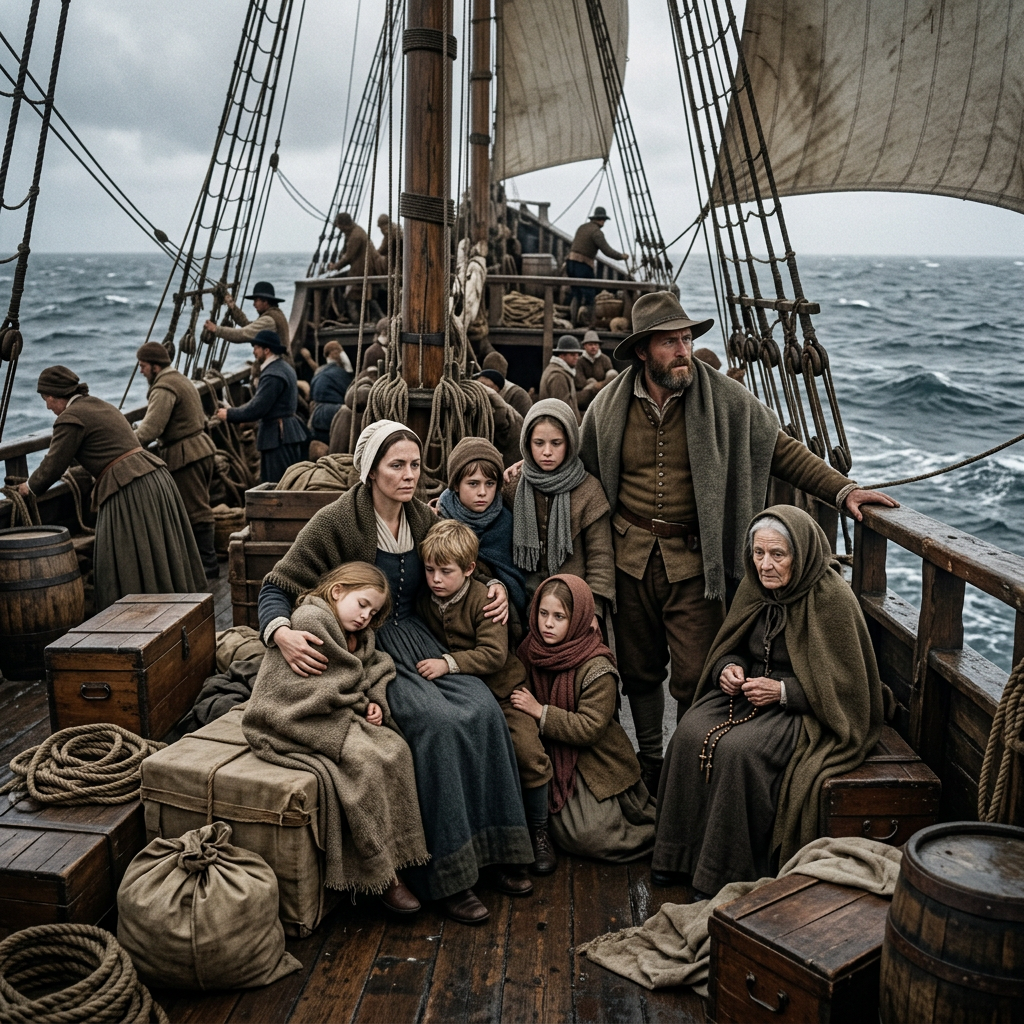
John Lanier (c. 1631–1719)—the son of royal musician Clement Lanier and Hannah Collet of Greenwich—found himself coming of age in this hostile, dangerous environment. He watched his family’s generational wealth evaporate and their social standing plummet under the anti-Royalist regime, where their past glories were now viewed as political liabilities. Recognizing that a Puritan-ruled England held no future for a family of displaced royal musicians, John sought economic salvation and political sanctuary far across the Atlantic. The expanding English colonies in North America offered a tantalizing, albeit terrifying, prospect for a new beginning, free from the immediate political persecutions of Cromwell’s government. Sometime before 1656, John and his young wife Lucreece made the perilous decision to abandon the sophisticated, paved streets of Greenwich, booking passage on a harrowing, months-long voyage to the Virginia Colony.
The transition from the epicenter of European high culture to the colonial frontier was remarkably jarring. Unlike his courtier ancestors who had thrived on the refined arts of chamber music, oil painting, and poetry in velvet-draped palaces, John stepped off the ship into a brutal, unforgiving wilderness. 17th-century Virginia was a society structured entirely around raw agrarian labor, resource extraction, and survival against endemic disease, extreme weather, and hostile indigenous populations. The delicate skills of the court were utterly useless here; survival demanded sheer physical endurance.
However, the innate resilience that had carried the family from Tuscany to Rouen to London prevailed once again. John adapted with stunning speed to the harsh colonial economy. He secured substantial land grants south of the James River in Charles City County (an area that would later become Prince George County). The region was raw, swampy, and heavily forested, requiring immense, back-breaking physical labor to clear for cultivation. Abandoning the flute and the cornett, John applied himself to the lucrative, labor-intensive cash crop of the era: tobacco. By mastering the complex, grueling logistics of planting, curing, and exporting tobacco back to the very country he had fled, he established himself as a highly successful planter. This pivot permanently altered the trajectory of the Lanier lineage, grounding them deeply in the soil, commerce, and culture of the early American South, transforming them from artists to agrarian capitalists.
5. Bacon’s Rebellion and the Southern Legacy (1676 Onward)
John Lanier was not merely a passive farmer; he possessed the leadership qualities and political acumen of his ancestors, quickly becoming a vocal, respected figure among the south-side frontier planters. By 1676, the Virginia colony was a powder keg. Rising tensions over frontier defense against frequent Native American raids (particularly by the Susquehannock) reached a boiling point, exacerbated by plummeting tobacco prices and high taxes. The colonial government, led by the aging Royal Governor Sir William Berkeley, was perceived as corrupt, playing favorites with wealthy tidewater elites, and refusing to protect the exposed outer settlements from attack.
The frustrated planters formed a military encampment at Jordan’s Point and selected John Lanier and John Woodlief as their representatives. They traveled to Jamestown to directly petition Governor Berkeley for a legal commission to bear arms and form a militia to defend their homes. Berkeley, furious at the presumption of the frontiersmen and fearful of an armed populace he couldn’t control, flatly and aggressively refused. This rejection was the primary spark that ignited Bacon’s Rebellion—the very first armed uprising by colonists against English rule in North America, occurring exactly one hundred years before the American Revolution. Undeterred by the Governor’s threats of treason, Lanier rode alongside the charismatic Nathaniel Bacon, fighting in a rebellion that fundamentally challenged colonial authority and ultimately resulted in the burning of Jamestown.
Though Bacon died of dysentery and the rebellion was subsequently crushed by English naval forces, John Lanier survived the ensuing royal purges, confiscations, and hangings orchestrated by a vengeful Berkeley, likely protected by his growing wealth, his strategic alliances, and perhaps a degree of pragmatic discretion following Bacon’s death. He lived to see the dawn of the 18th century, dying around 1719, and leaving behind a sprawling, heavily fortified legacy that had weathered yet another revolution.
A pivotal moment that secured the family’s ultimate social triumph in the New World occurred when John’s son, Sampson Lanier (c. 1682–1743), married Elizabeth Washington (a cousin of future president George Washington) around 1706. This strategic union integrated the Laniers into the absolute highest tiers of Virginia’s agrarian aristocracy—the powerful network of families known as the “First Families of Virginia.” From those original, hard-won tobacco fields in Charles City County, subsequent generations of Laniers expanded outward, fueled by land wealth and strategic marriages. Serving as revolutionary war officers fighting for independence, influential state politicians shaping new governments, prominent physicians, and pioneering planters, they pushed deeply into North Carolina, Georgia, Alabama, and across the broader American South. Their influence shaped the development of these new states, forever cementing the Lanier clan as a foundational pillar of American history, far removed from their Tuscan origins but defined by the same enduring adaptability.