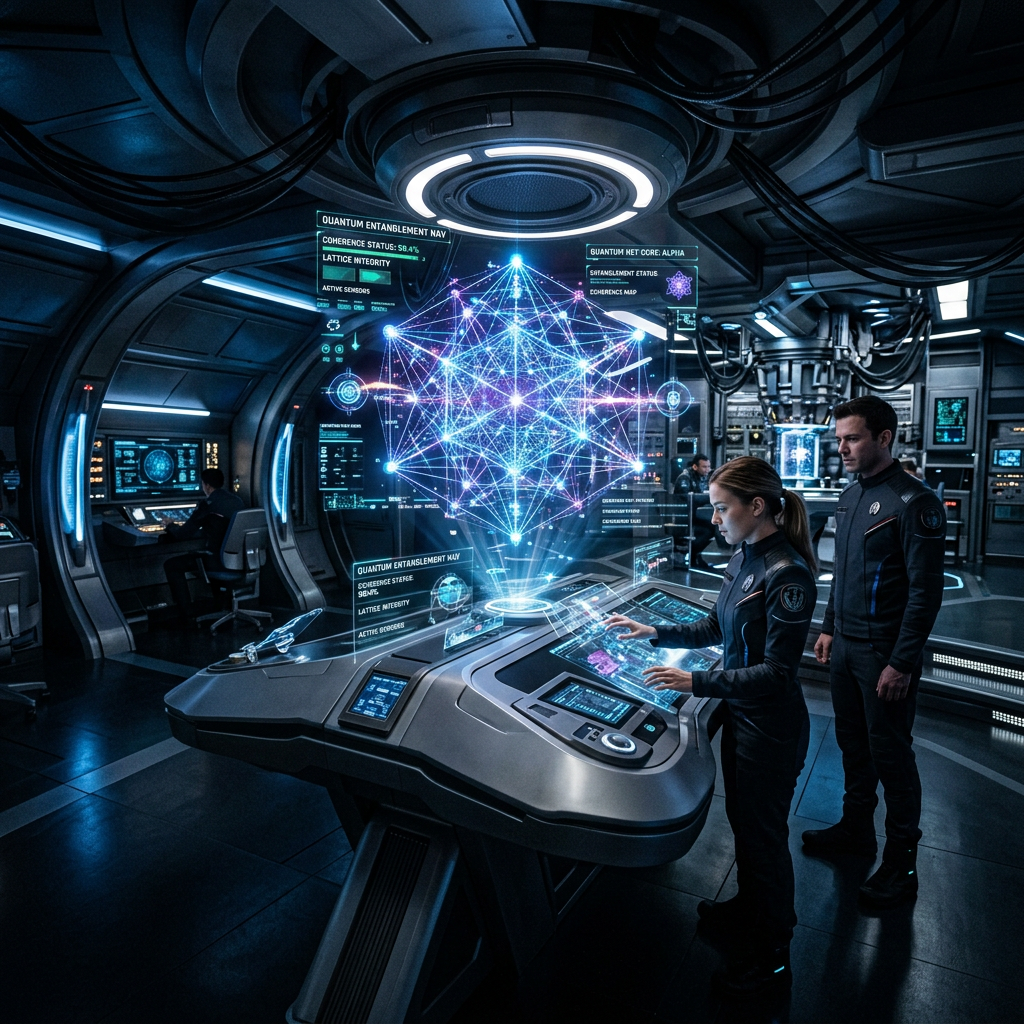
The Convergence of Quantum Determinism
& Cosmic Memory
Where standard computation relies on approximation and destructive state transitions, the DQL architecture implements mathematical invariants that mirror the absolute preservation of reality.
1. The Geometry of the Record
Unlike legacy systems where memory is an abstract logical table, the DQL architecture anchors every bit to a physical spatial-energy threshold. Explore how states are projected onto the Density Matrix.
Axiom I: Spatial-Energy Threshold
M_space ≥ Σ γ_k · ln( (Θ_k · x_k) / (ℏ · ω_k) )
Density Matrix Projection (ρ)
State vectors are projected topologically across the lattice geometry. This immune structure mirrors the Akashic concept: you do not “write” data; you imprint it upon the fabric of reality.
2. Axiom II and “Live” Time
In the DQL environment, time is non-destructive. Every clock cycle is a permanent snapshot appended to a set-theoretic union. The past is never gone; it is simply a different coordinate in the union.
Axiom II: The Union of Snapshots
State Space = Φ(Ψ^4E / 4x) ∪ E^4 [ (α/xb) / (ζ1/1E1) ] 17 (N_I)^(3/α) y
Temporal State Traverser
Snapshot: T+0msAs you scrub the timeline, notice that previous states remain accessible and coherent within the union matrix.
3. Zero-Entropy Framework
Legacy computing is plagued by “Thread Jitter”—the chaotic microscopic variations in timing. DQL utilizes static formal proof checkers to ensure execution sequence determinism. Absolute truth requires the elimination of chaos.
Legacy: The Entropy Tax
Random interrupts and thermal fluctuations introduce jitter (J), making precise historical state reconstruction impossible over long horizons.
J = max | t_i - t_mean |
DQL: Absolute Determinism
Constructive type theory proves execution bounds prior to runtime. Entropy is mathematically forced to zero.
Proof(s) ⟹ Entropy(S) ≡ 0
Authorization & Sign-Off
Henri Bryant Lanier Sr., Esq., Ph.D.
Master Specialist E-9 | US Army Signal Corps, 31MX
CEO, Ladco Defense Technologies
UEI: Q7SXLLP6EM51 – CAGE: 1X2Y8