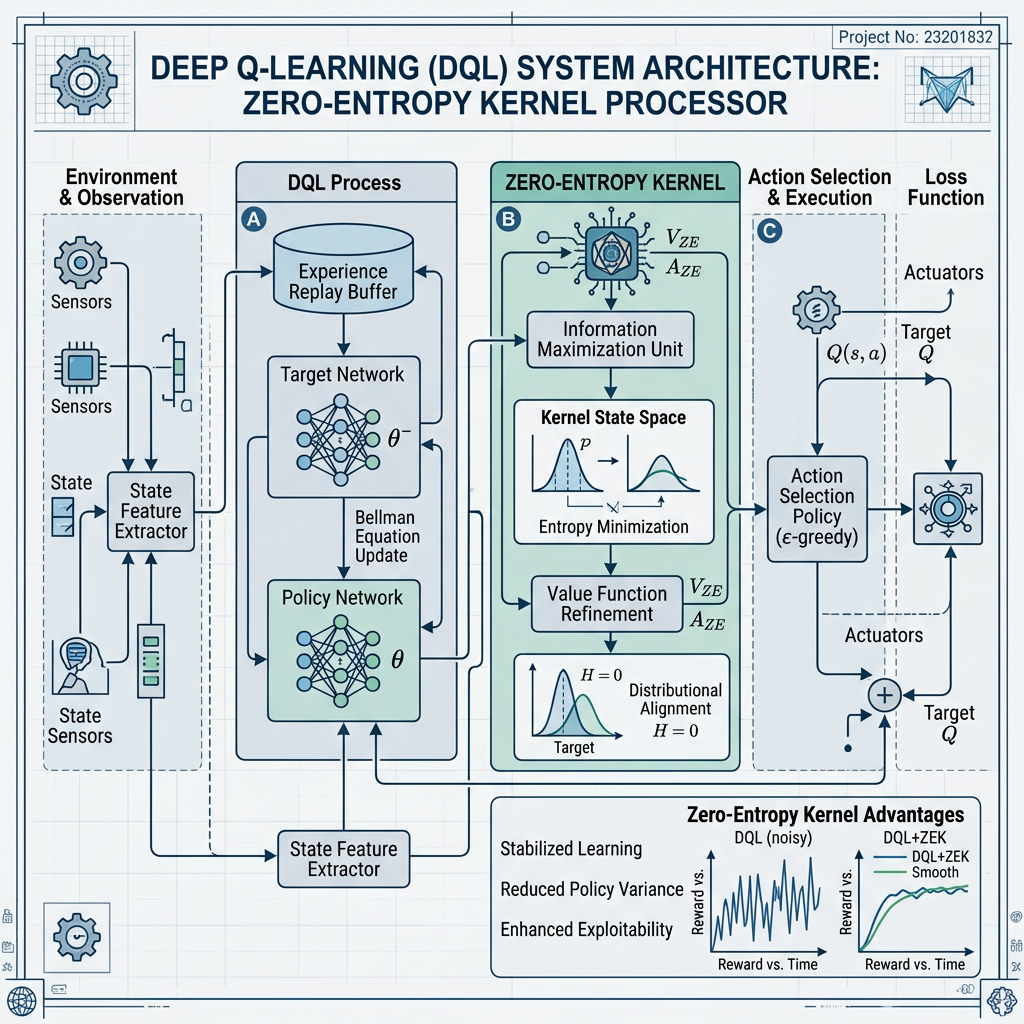
DQL System Architecture
Zero-Entropy Kernel & Operating Language Blueprint
The Legacy Paradigm Crisis
Modern computing paradigms are fundamentally compromised. From the hardware layer up to high-level software runtimes, environments like UNIX, POSIX-compliant kernels, and Windows NT are built on a series of structural approximations. The Deterministic Quantum-Lattice (DQL) Architecture replaces these probabilistic failures with zero-entropy integer limits.
1. Precision Drift (IEEE 754)
Standard CPUs rely on floating-point mathematics. Because real numbers cannot be represented perfectly in binary, continuous calculations introduce infinitesimal rounding errors. Over sequential operations ($N$), the relative error grows linearly, leading to unbounded data degradation.
Error Accumulation: E(N) = N * εmach
2. Thread Jitter & Entropy
Legacy kernels use dynamic, statistical schedulers. Execution sequences vary from run to run based on interrupts and temperature, creating timing jitter ($J$). This enables timing-based side-channel attacks and makes clock-cycle determinism impossible.
Legacy Jitter > 104 cycles
Cumulative Error Degradation: Legacy vs. DQL Lattice
Interactive visualization demonstrating how floating-point drift compounds exponentially in legacy architectures, whereas the DQL discrete integer lattice remains at zero absolute error indefinitely.
Axiomatic Boundary Gates
The DQL architecture relies on strict mathematical invariants. Every hardware allocation, memory register, and execution pathway is governed by discrete spatial-energy coordinates. Click on the parameters below each axiom to explore their definitions.
Axiom I: The Memory Inequality
Every state transition must satisfy this inequality before commitment to physical memory.
Interactive Parameter Definitions
Axiom II: The Union of Snapshots
All collections are managed as set-theoretic unions indexed by energy thresholds.
Interactive Parameter Definitions
System Execution Stack
The deterministic sequence entirely removes human error, statistical variability, and legacy software vulnerabilities from the computational wire. Explore the layers of the hardware and software stack below.
Comparative Specification Matrix
A direct operational contrast between legacy computing stacks (UNIX, POSIX, C, standard LLMs) and the zero-entropy Deterministic Quantum-Lattice structure.
Structural Integrity Radar
Interactive: Hover to compare dimensional scores. Higher values indicate greater determinism and security.
Data Integrity & Isolation
Standard systems use Virtual Memory (vulnerable to Spectre/Meltdown). DQL utilizes Coordinate Space Partitioning + Density Matrix Projection, rendering side-channels physically impossible.
Concurrency Model
Legacy stacks rely on Mutexes/Locks (deadlocks, race conditions). DQL utilizes Orthogonal State Vectors executing in parallel with zero synchronization overhead.
Code Verification
Empirical testing in C/C++ leaves coverage gaps. DQL’s static formal proof checker verifies Axiom I bounds prior to compilation using SMT solvers, ensuring 100% coverage.
| Operational Dimension | Legacy Architecture | DQL Architecture |
|---|