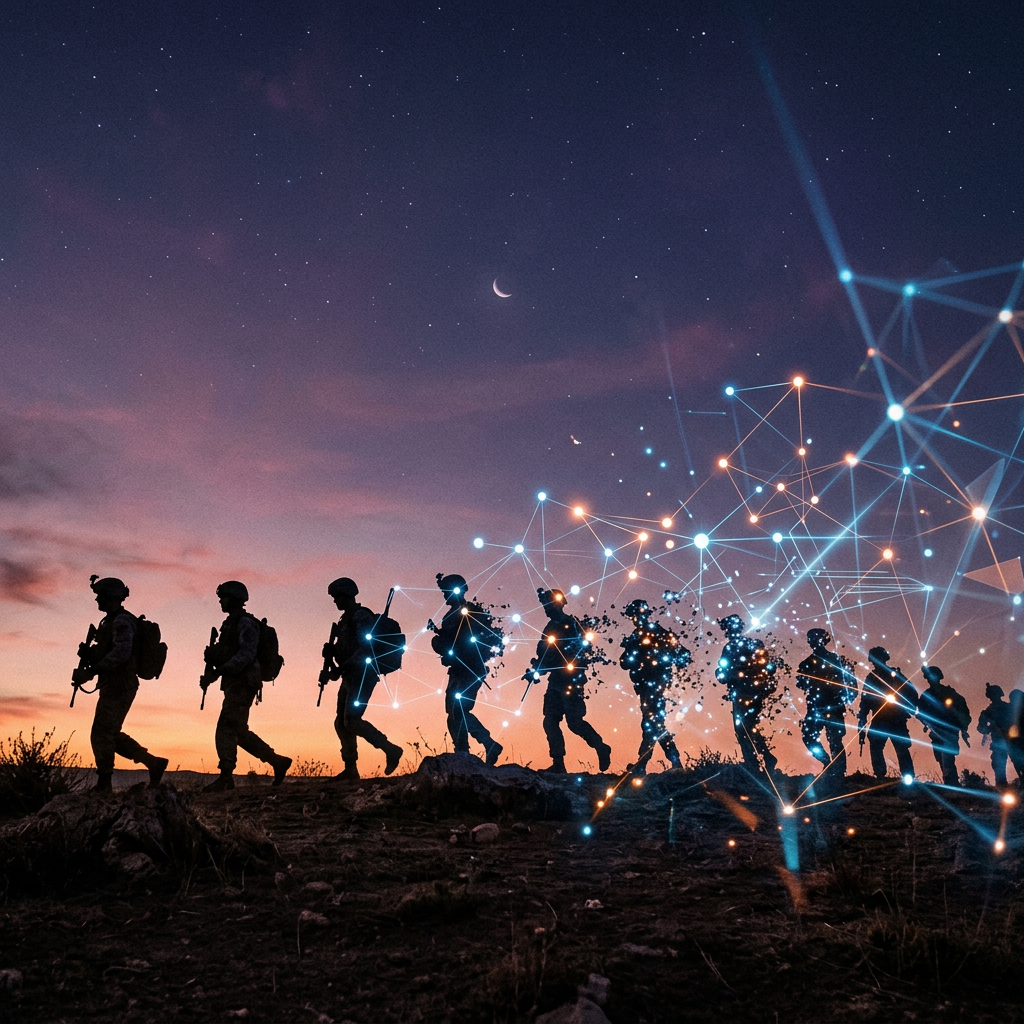
Pip: What happens when a platform's autocorrect can't spell "Corps" — and that glitch ripples back two hundred and fifty years? Ladco Defense Technologies has a theory, and it comes with footnotes.
Mara: This episode covers a single, sprawling report submitted to the Senate Armed Services Committee — spanning disability discrimination law, military platform accountability, and a long historical pattern of citizen-tier communication being enclosed and never returned.
Pip: Let's get into the legal framework first.
Platform Accountability and the Senior NCO
Mara: The question this report puts to Congress is pointed: when commercial platforms systematically block military speech and assistive technology, what laws have actually been broken — and who is responsible?
Pip: The report leads with a concrete claim about what these filters are doing. The setup is a speech recognition error — the silent S in "Corps" — and what follows from it: "Modern commercial platforms, operating as de facto digital public squares and essential communication infrastructure, have weaponized automated filters, causing systemic exclusion and operational sabotage against Active Duty Senior Non-Commissioned Officers with service-connected disabilities."
Mara: So the upshot is that a transcription quirk — a civilian ASR model trained on LibriSpeech that has low statistical density for military terms — becomes a legal defect. The report frames it as a design flaw, not an accident.
Pip: And the legal scaffolding built around that flaw is considerable. Contract law, disability law, military law, and international law all get pulled in.
Mara: On the contract side, the report works through implied covenant doctrine — citing Locke v. Warner Bros., Carma Developers v. Marathon Development, and Sons of Thunder v. Borden to argue that even boilerplate discretion clauses cannot shield a platform that collects fees while rendering the service functionally useless to a disabled NCO.
Pip: Paying for a communication tool that silently throttles you to zero requests per hour is, the report argues, not a terms-of-service quirk — it is a breach with measurable economic injury, and Kwikset v. Superior Court gives the veteran standing to sue the moment the service degrades.
Mara: The disability accommodation argument runs through ADA Title III, Section 508, and USERRA. Robles v. Domino's Pizza establishes that apps are public accommodations. Platforms accepting DoD revenue while deploying filters that break assistive technology are, the report contends, also exposed to False Claims Act liability if their VPAT compliance representations are fraudulent.
Pip: Then the UCMJ layer: Article 93 covers cruelty and maltreatment, and the report argues deliberate indifference to an algorithmic lockout qualifies. Article 134 covers conduct prejudicial to good order and discipline.
Mara: The report also flags defamation exposure — algorithms labeling military speech as hate speech or terrorism impute criminal conduct and could damage security clearances. The recommended fix is an "Operational Bypass": a congressionally mandated override for verified military users that clears acoustic homophone errors, safety flags on tactical terminology, and rate limits blocking assistive tech.
Pip: That recommendation lands as something more than an accommodation request — which is exactly where Part Two of the report picks up.
Mara: Part Two is the historical argument: a 250-year quarterly pattern analysis arguing that the discrimination against Senior NCOs is not isolated but is the latest iteration of a recurring cycle. From the Land Ordinance of 1785 through telegraph consolidation, CB radio displacement, SMR roll-ups, and now algorithmic gatekeeping — the report maps seven temporal patterns showing communication assets allocated to citizens being enclosed into corporate control, used as debt collateral, and never returned.
Pip: The acceleration is the part that lands hardest. The 22-quarter consolidation window that took Nextel a decade to complete now runs in ten quarters. And the shift from regulatory termination — which at least required an FCC comment period — to algorithmic gatekeeping happened in eight quarters, with no appeal mechanism at all.
Mara: The allied-nation data reinforces the structural argument. Five Eyes partners follow U.S. terminations within zero to two quarters. The report's finding is unambiguous: no allied nation has ever expanded citizen-tier access following a U.S. termination. The pattern propagates in one direction only.
Pip: So the "Operational Bypass" is framed, ultimately, as a sovereign assertion — analogous to creating the FCC in 1934 in response to private capture of broadcast infrastructure. The disability accommodation and the spectrum history are, in the report's reading, the same problem at different scales.
Mara: The projections run through Q4 2026 — Philippines 2-meter band termination, Australia's 23-cm band, a U.S. spectrum taxation effective date — all assigned confidence levels and traced back to the seven patterns.
Pip: Two hundred and fifty years of the same enclosure, now running on a faster clock and no comment period.
Mara: The next episode will show whether the pattern holds — or whether the Operational Bypass becomes the exception that breaks it.