
Part I: The Copper and the Pines
The sun cast its rays through the threadbare towel hanging across the wooden-paned windows of the Jim Walter home demo. It sat on my grandparents’ lot—a hollow shell of a house, a “demo” meant to sell a dream of homeownership to those with little more than a piece of dirt and a willingness to sweat. In the mid-seventies, these homes were the heralds of a new kind of self-reliance, promised to be “shell-finished” so a man could frame his own destiny within their walls. It was a skeleton of a house, a stage-set of a domestic life meant to show what existence could be if you only had the credit or the courage to finish what the builders started. It rested on the stark, unpaved reality of a dead-end dirt road in the Sandhills of Pine Ridge, South Carolina—a place where the soil was more silica than earth, a white, hungry sand that swallowed everything from spilled oil to secrets.
To a nine-year-old in July 1975, this wasn’t just a structure; it was a sanctuary of transition, a half-finished promise of a future that felt both imminent and impossible. The house seemed to wait for walls that were never coming, its open studs like the ribs of a great, beached beast bleached by the Carolina sun, just as I waited for a manhood I couldn’t yet define. The interior was a labyrinth of raw pine and exposed wiring, smelling of sawdust and the dusty potential of rooms that had no names. The air is already heavy at nine in the morning, a physical weight that smells of damp earth, pungent pine resin, and the metallic, ozone promise of a coming afternoon storm that would inevitably crack the sky open and steam the world clean of its dust, only to leave it more humid and suffocating than before.
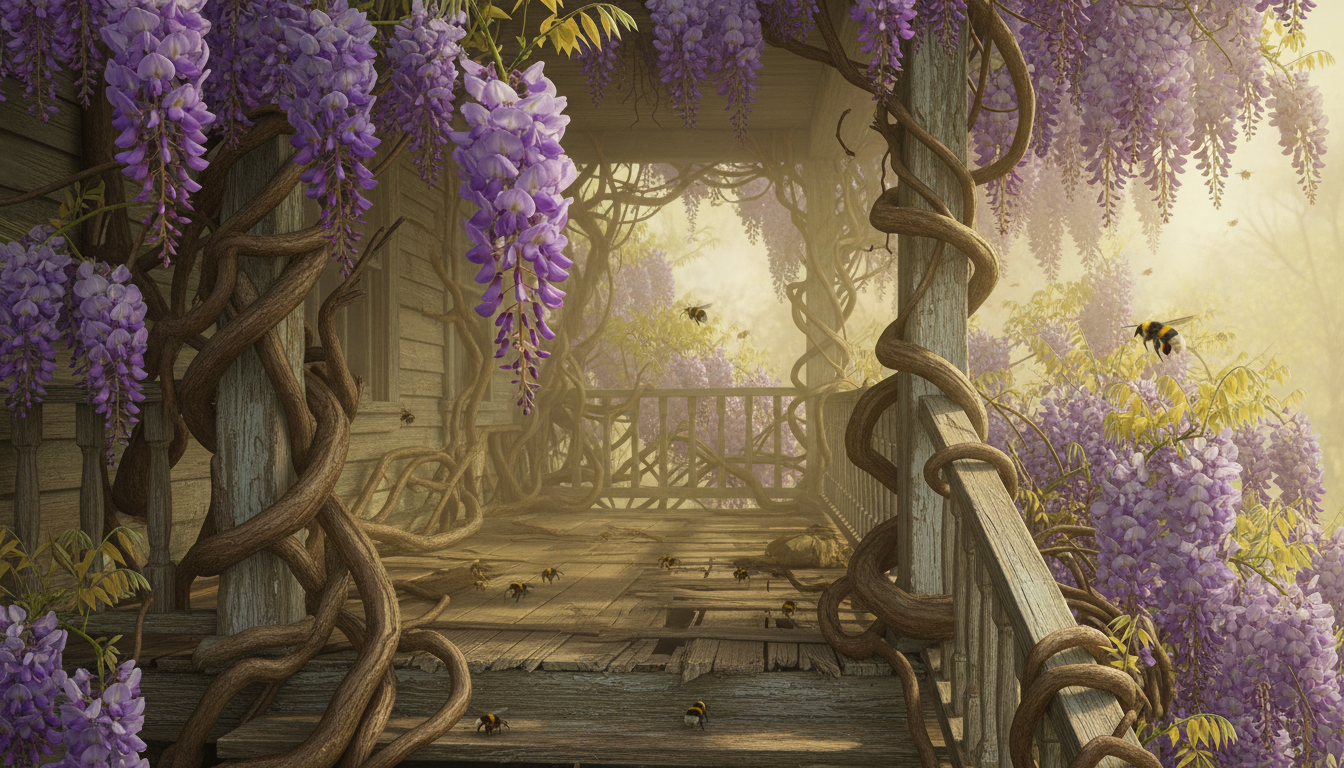
The world outside the demo windows is a fever dream of growth and decay, a Southern gothic landscape where nature is constantly, aggressively trying to reclaim the wood and wire of man. The wisteria vines are heavy and alive, a thrumming wall of purple flowers that seem to breathe in the suffocating humidity, their fragrance so thick and cloying it felt like something you could chew, a floral syrup that coated the back of the throat and lingered like a fever. They buzzed with the low-frequency vibration of bumblebees fat with nectar and heavy with the heat, moving like tiny, furred satellites orbiting a world governed entirely by scent and nectar. The vines grew with such ferocity that you could almost hear the wood of the porch groaning under their weight, a slow-motion strangulation disguised as a garden, a reminder that in the Sandhills, if you stood still too long, the earth would try to take you back.
Old Boots, the hound dog, is on his chain—a rusted link to a world he once dominated with his nose and his speed. His life was now measured in the radius of that iron tether, a circle of beaten earth where no grass dared to grow, smoothed into a hard-pan floor by the repetitive pacing of a predator with nowhere to go. His ears twitch at the ghosts of foxes he can no longer chase, and he barks a rhythmic, hollow warning at the rising heat, a sound that echoes off the woodpiles of the nearby mill like a bell tolling for a lost hunt. It was a bark born of duty, not anger, a declaration that he was still there, a sentinel of the yard, even if his world had shrunk to the length of a ten-foot lead and the shade of a single chinaberry tree. Every bark was a punctuation mark in the long, hot sentence of the morning, a rhythmic heartbeat of a yard held in the grip of July.
Inside, the domestic symphony begins, orchestrated by the women and the machines of the home. I hear my grandmother at her stove, the hinge screeching—a sharp, metallic protest that Grandpa always said shouldn’t happen, but it did anyway, day after day, year after year. It was the sound of the house waking up, a ritualistic friction that spoke of use, of age, and of a stubborn refusal to be silenced by a drop of oil. It was as reliable as the sunrise and twice as loud, a constant companion to every meal she ever burned or blessed. Every time that hinge cried out, it felt like a reminder that even the most ordinary parts of our lives required a struggle to function, a mechanical prayer for the day ahead. It was the sound of persistence, the high-pitched voice of a kitchen that had seen enough grease and fire to know it would outlast us all. My grandmother ignored it with a practiced ease, her movements synchronized with the screech as if it were a necessary part of the recipe, the music of a life lived in service to the hearth.
Tom, that yellow cat, is a golden weight on the hood of my grandfather’s car, his body vibrating with a purr that matches the frantic, electric hum of the cicadas in the distance. He is a creature of pure comfort, soaking up the residual heat of the engine and the direct, unforgiving glare of the sun until his fur felt like it might ignite under a child’s touch. He was the only thing in the yard that seemed to truly own the heat, rather than merely endure it. Life is happening in the microscopic cracks of the house; ants race around the windowsill screen in a frantic, black line, a miniature highway of industry that never slept. They are rushing to scarf up the remains of a fly that never quite made it out of the wolf spider’s web—a fly that had spent its final moments buzzing against the mesh, so close to the freedom of the wisteria, only to be dragged back into the shadows of the counter by a predator that knew the value of silence and patience. The wolf spider didn’t hurry; it simply existed as the inevitable conclusion to the fly’s ambition, a dark, hairy god of the baseboards, presiding over a tiny, silken graveyard hidden in the corners of our world.
On the counter sits the old dial radio, a plastic box of static and soul, yapping into the distance. The signal drifts in and out on the humid air, caught between the tall pines and the power lines, as Freddy Fender sings “Before the Next Teardrop Falls.” His voice is a bridge between the English and the Spanish, a bilingual lament that felt like the very soul of 1975—a year caught between the old ways and the new, between the rural silence of the past and the encroaching, neon noise of a modern South. The radio was the oracle, a humming presence that brought the collective heartache of the world into our kitchen, and Freddy was the high priest of our Saturday morning, his vibrato shaking the very jars of preserves on the shelf. The music didn’t just play; it saturated the wood of the counter, becoming part of the atmosphere we breathed, a frequency that synchronized with the tapping of the flour can.
A blue jay lands on the sill, a shock of aggressive azure against the grey screen, barking at me with a sharp, insistent chatter. He cocks his head, eyeing me with a predatory curiosity, demanding entry into a world he wasn’t born to inhabit. He is a feathered sentinel marking the boundary between the domestic and the wild, a blue-and-white warning that the woods were watching us back, impatient for our departure. I can smell the oak handle of the old frying pan beginning to singe, that toasted, woody scent that meant the iron was finally hot enough to sear whatever was placed within it. It was a smell that promised breakfast but also whispered of forest fires, scorched earth, and the destructive power of heat.
For a split second, I am struck by a strange, adult terror—the realization that this moment is already becoming a memory even as I live it. The intensity of the sensory details—the singe of the oak, the blue jay’s bark, the weight of the humidity—is so sharp that it feels like it’s being branded into my mind. I feel the ghost of the man I will become—the fifty-nine-year-old me—looking back at the boy I am through the lens of nearly half a century, reaching through time to memorize the specific frequency of the radio’s hum and the white glare of the sand before they are lost to the wind of years. I am a witness to my own childhood, standing in the doorway between the boy who feels and the man who remembers.
But then the sound brings me back to the present.
I can hear him. Grandpa is tapping the can.
He had fashioned a sifter from a discarded tin, a relic of necessity layered with three sheets of screen salvaged from an old front porch door we had worked on together. He believed that the mesh of the porch door, which had kept out the South Carolina mosquitoes and the “bad spirits” of the night for decades, was the only thing fine enough to catch the impurities of the modern age. The wire wasn’t just flat; he had pinched and arranged it into three distinct points, a trinity of filtration that he claimed caught the “grit of the world” before it could enter the body. He bound the whole apparatus with a heavy, tarnished copper wire around the top, twisted into a tight, permanent grip that seemed to pulse with a life of its own whenever the light hit it. It was a crude machine, but in his hands, it became an instrument of profound intent, a holy alchemy of tin and screen.
I watched his weathered fingers—mapped with grease, scars from the sawmill, and the deep lines of a man who worked with his hands until the skin was like seasoned leather—moving with a precision that bordered on the holy. He would twist that copper, and I could hear the tension in the metal, a high-pitched whine of stress, before the thrum-tap-thrum began. He was sifting the Adluh flour until it was a fine, white mist, a cloud of dust that caught the shafts of sunlight and turned the kitchen into a cathedral of flour and light. He never trusted the store-bought sifters, the shiny, flimsy things from the Sears catalog that broke after a month and felt like toys in his massive hands. “Copper be best for demons,” he would mutter, his voice a low gravel that seemed to vibrate in his chest, his eyes tracking the snowy fall of the flour. “And all copper be best for life.”
To him, copper was the great conductor, the metal that could ground the spirit and ward off the unseen forces that gathered in the dark corners of the Sandhills. He believed that the impurities in the store-bought flour weren’t just husks and bugs, but the very “bad air” of the town, the residue of a world losing its connection to the earth. He saw the world in terms of conductivity and insulation—you either invited the spirit in or you screened it out. In that kitchen, flour wasn’t just the base for biscuits; it was a substance being purified by the ancient metal of the earth. The sifter was a holy machine, a protective barrier intended to keep the “audluh” flour pure and the darkness at the edge of the dirt road from leaking into our bread and, by extension, our souls. He believed in the conductivity of the soul, and that sifter was his lightning rod, his primary defense against the entropic decay of the world. It was his way of sifting the good from the evil, the life from the rot, ensuring that what we took into ourselves was as untainted as the morning sun. Every tap of the can was a rejection of the outside world’s chaos.
But today is a “go-to-the-woods” day. The calls of the house, the safety of the copper, and the familiar screech of the stove hinge are losing their grip on me. The kitchen felt like a fortress, a place of copper-guarded certainty, but the forest felt like a destination, a place where the air was different and the rules were yet to be written. The curiosity of a nine-year-old is a stronger force than the fear of demons, or perhaps it is the first demon I ever encountered—the need to know what lies beyond the fence, even if it means leaving the light of the kitchen and the protection of the copper. I was beginning to realize that Grandpa’s copper might keep the demons out, but it also kept the boy in, and the boy was ready to be out.
I leave the sanctuary of the kitchen, the air growing thin and silent behind me, the smell of singed oak replaced by the dry, rising smell of dust and sun-baked sand. I head for the hallowed forest pines out past the back gate, leaving the “Jim Walter” dream behind for the reality of the timber. I am a small ghost in a t-shirt, stepping around the weathered gatepost and sliding my frame under the biting, rusted teeth of the barbed wire. The “bob-wire,” as we called it, was the only thing standing between the civilized dirt of the yard and the wild, ancient sand of the forest floor. It was a jagged, steel boundary that tasted of rust and warning, leaving a faint metallic scent on my fingers as I pushed it up just enough to crawl through, the barbs snagging for a second on my shirt like a hand trying to hold me back from the threshold.
I skip across the woodpiles from the truss plant sawmill—mountains of pine and oak that smelled of raw, screaming timber and fresh sawdust. It was an intoxicating, violent scent, the smell of the forest being turned into the world of men, a massacre of trees that smelled like progress and sweat. Each pile was a fortress, a maze of sap and splinters where a boy could disappear into a world of hidden tunnels and unstable heights. The logs were still sticky with resin, the amber lifeblood of the pines weeping out onto the sand like honey. I keep one eye on the mean old dogs that patrol the perimeter of the mill—beasts that looked more like wolves than pets, their ribs showing through matted fur and their eyes yellow with a territorial hunger that felt older than the town itself. They didn’t bark so much as snarl, a sound that rumbled in the dirt under my feet, warning me that I was a trespasser in a place of violent industry where man took what he wanted from the earth with loud saws and sharp teeth.
My other eye is glancing back, drawn by a different kind of danger—one that didn’t bark or bite but pulled at me with a magnetic force that was entirely new and vaguely frightening. I wanted to see if she was there. The pretty girl who lived beside us.
She was a fixture of the periphery, a constant distraction from the path to the pines. She was always out in the back, wagging her fanny at the world with half her clothes off, a vision of forbidden sun and tan skin that didn’t fit into my grandmother’s Sunday school lessons or my grandfather’s copper-bound logic. She was the disruption in the system, a living question mark on the edge of the property line. She smiled a lot—not the polite, practiced smile of the church pews, but a wide, knowing grin that she only wore when her mama wasn’t looking. It was a smile that promised secrets and suggested that the world outside the gate was a place where the rules of the kitchen didn’t apply, where the demons my grandfather feared might just be the very things that made you feel most alive. She was the first chapter in the Story of Man that my grandfather hadn’t warned me about, the first evidence that there was a beauty in the world that was also a type of peril, a heat that copper couldn’t ground and that no screen could filter out. She was the sunlight that refused to be sifted.
I turn my back on the house, the fading, static-filled lament of Freddy Fender, and the girl’s silent, half-clothed invitation. I walk into the pines. The light changes instantly here, turning from the white, blinding glare of the yard to a bruised, filtered green that feels like being underwater in a stagnant pond. The temperature drops ten degrees in a single step, the air cooling as the canopy closes over my head like a tomb. The sound of the world—the sawmill, the radio, the barking dog—is muffled by a thick, damp carpet of needles that swallows my footsteps and silences the heartbeat of the town. The air here smells of decay and ancient growth, a scent far removed from the Adluh flour and the copper wire. It is the smell of time itself. The Story of Man is beginning in the silence of the trees, in the space where the copper sifter can’t reach and the demons have names I haven’t learned yet. The hot, white dirt under my feet is the only map I have to the person I am supposed to find, and the silence of the pines is the only witness to my crossing.