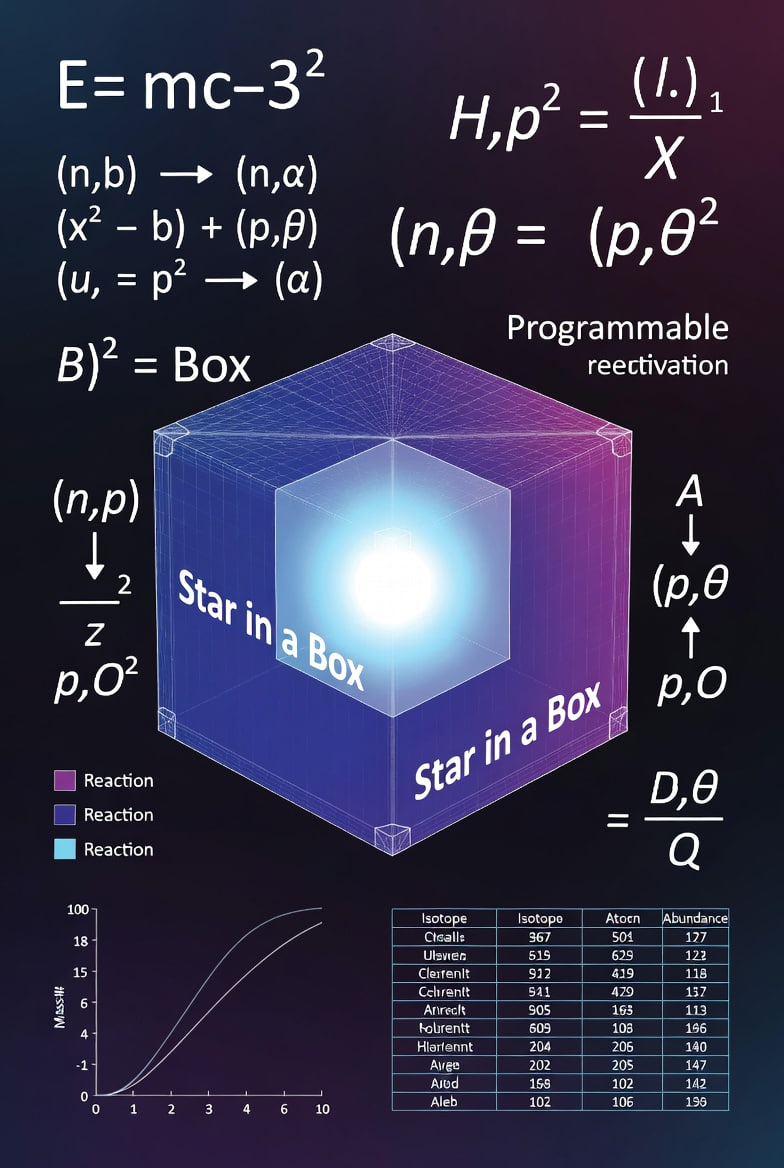
The concept of a programmable nucleosynthesis system represents the ultimate convergence of plasma physics, nuclear astrophysics, and advanced control engineering. Often described by the metaphor of a Star in a Box, this theoretical framework seeks to replicate the elemental production capabilities of stellar interiors within a controlled terrestrial environment. While the term Star in a Box has historically served two distinct purposes—an educational tool developed by the Las Cumbres Observatory Global Telescope (LCOGT) for teaching stellar lifecycles and a computational setup for 3D radiation-hydrodynamics simulations like CO5BOLD and Seven-League Hydro (SLH)—its evolution into a physical engineering proposal marks a transition from observation to synthesis. The engineering objective of such a system is the controlled assembly of atomic nuclei, moving beyond the simple fusion of light isotopes for energy and toward the targeted manufacturing of the entire periodic table.
The mathematical foundation of this system requires a rigorous integration of several disciplines. It must account for the high-temperature plasma confinement necessary to overcome the Coulomb barrier of heavy elements, the complex reaction networks that govern isotopic transitions, and the thermodynamic quenching required to extract stable products. The following analysis explores the scaling laws, kinetic equations, and operational constraints that define the limits of this technological frontier.
Plasma Confinement and Stability at Extreme Temperatures
To achieve the nucleosynthesis of elements beyond helium, the plasma must be sustained at temperatures significantly higher than those targeted for commercial deuterium-tritium fusion. While a D-T plasma typically requires temperatures in the range of 10 to 15 keV, the synthesis of heavier elements such as carbon, oxygen, and iron necessitates operating regimes between 100 keV and 500 keV. This increase in temperature introduces profound challenges for plasma confinement and stability.
The Modified Lawson Criterion for Multi-Element Synthesis
The Lawson criterion traditionally defines the triple product of density, temperature, and confinement time required for a fusion plasma to reach ignition. In a programmable nucleosynthesis system, this criterion must be generalized to account for a multi-species plasma where every nuclear reaction step is a deliberate engineering goal rather than a byproduct. For each reaction producing a target element $j$ from precursor elements $i$ and $k$, the condition for a sustained reaction rate is expressed through a modified energy balance: $$n_i \cdot n_k \cdot \langle\sigma v\rangle_{i,k} \cdot \tau_E > \frac{Q_{i,k}}{P_{loss} + P_{brems}}$$
In this equation, $n_i$ and $n_k$ represent the number densities of the reacting species in units of m⁻³, and $\langle\sigma v\rangle_{i,k}$ is the Maxwellian-averaged cross-section for the reaction (m³/s). The energy confinement time $\tau_E$ (s) measures the rate at which energy is lost from the system. $Q_{i,k}$ is the energy released per reaction in Joules. The denominator terms, $P_{loss}$ (total power loss density) and $P_{brems}$ (bremsstrahlung radiation loss density), are critical because they scale aggressively with the atomic number of the species present in the plasma. Unlike a D-T reactor, where the “ash” is primarily helium, a programmable system intentionally introduces or produces high-Z elements, which dramatically increases radiative losses. This necessitates a massive increase in external heating power to maintain the energy balance.
Magnetic Confinement Scaling and the Troyon Limit
To sustain the pressures required for heavy-element synthesis, the system must utilize advanced magnetic confinement, typically in a tokamak or stellarator configuration. The performance of these devices is constrained by the beta limit ($\beta$), which is the ratio of plasma pressure to magnetic pressure. The maximum achievable beta is governed by the Troyon scaling law:
$$\beta_{max} = 0.028 \cdot \left(\frac{I_p}{aB_T}\right) \cdot \frac{1 + \kappa^2}{2}$$
The variable $\beta$ itself is defined as:
$$\beta = \frac{n_e T_e + n_i T_i}{B^2 / 2\mu_0}$$
For a system operating at 100 keV, the parameters must be scaled to avoid magnetohydrodynamic (MHD) instabilities such as the kink mode or vertical displacement events. Using an ITER-like baseline for high-temperature operation, we can establish the following performance requirements:
| Parameter | Symbol | Target Value (100 keV Synthesis) |
| Toroidal Field | $B_T$ | 13 T |
| Plasma Current | $I_p$ | 15 MA |
| Major Radius | $R$ | 6.2 m |
| Minor Radius | $a$ | 2.0 m |
| Electron Density | $n_e$ | $1.0 \times 10^{20}$ m⁻³ |
| Ion Temperature | $T_i$ | 100 keV |
| Confinement Time | $\tau_E$ | 3.6 s |
| Normalized Beta | $\beta_N$ | 3.5 |
Data synthesized from ITER baseline projections and high-temperature plasma studies.
The normalized beta $\beta_N$ serves as a critical indicator of how close the system is to the stability limit. Maintaining $\beta_N$ at 3.5 while the plasma is loaded with heavy ions requires precise control over the current profile and the plasma shape. The Grad-Shafranov equation, which describes the equilibrium of a toroidally symmetric plasma, must be solved in real-time to adjust the external coil currents.
Nuclear Reaction Network Mathematics
The core of the “Star in a Box” is the reaction network that governs the transformation of isotopes. This is not a single reaction but a dense web of interconnected pathways, where the output of one reaction serves as the input for several others.
Gamow Peak Energy for Charged-Particle Reactions
Because atomic nuclei are positively charged, they repel each other via the Coulomb force. For a reaction to occur, the nuclei must have sufficient kinetic energy to tunnel through the Coulomb barrier. The probability of this tunneling is highest at the Gamow Peak Energy ($E_G$), which is determined by the charges $Z_1$ and $Z_2$ of the reacting nuclei and their reduced mass $m_r$:
$$E_G = (\pi \cdot \alpha \cdot Z_1 \cdot Z_2)^2 \cdot 2 \cdot m_r \cdot c^2$$
$$T_G = \frac{E_G}{k_B}$$
In these expressions, $\alpha \approx 1/137$ is the fine structure constant, $c$ is the speed of light, and $k_B$ is the Boltzmann constant. The Gamow energy dictates the optimal temperature ($T_G$) for a specific nucleosynthesis step. As the system moves from hydrogen burning to helium, carbon, and oxygen burning, the $Z_1 Z_2$ product increases, requiring a corresponding increase in the plasma temperature to maintain the reaction rate.
Reaction Rate Coefficients and Approximations
The reaction rate coefficient $\langle\sigma v\rangle$ is the integral of the reaction cross-section $\sigma(E)$ over the Maxwellian velocity distribution. For non-resonant reactions, which characterize much of the alpha-capture ladder, the following approximation is used to model the rate in m³/s:
$$\langle\sigma v\rangle \approx \frac{2.6 \times 10^{-18}}{Z_1 \cdot Z_2} \cdot \left(\frac{m_r \cdot c^2}{k_B \cdot T}\right)^{2/3} \cdot \exp\left(-3 \cdot \frac{(\pi \cdot \alpha \cdot Z_1 \cdot Z_2)^2 \cdot m_r \cdot c^2}{(2 \cdot k_B \cdot T)^{1/3}}\right)$$
This mathematical relationship highlights the extreme sensitivity of the synthesis process to temperature. A small fluctuation in $T$ can lead to an exponential change in the production rate of a specific isotope. In a programmable system, this sensitivity is exploited to “tune” the plasma to a specific reaction pathway while suppressing others.
Nucleosynthesis Rate Equations
The temporal evolution of the isotopic composition within the box is governed by a set of coupled differential equations. For each isotope $i$, the change in its number density $n_i$ over time is:
$$\frac{dn_i}{dt} = \sum_{j,k} (1+\delta_{jk})^{-1} \cdot n_j \cdot n_k \cdot \langle\sigma v\rangle_{j \to i} – n_i \cdot \sum_j n_j \cdot \langle\sigma v\rangle_{i \to j} – \frac{n_i}{\tau_{i,loss}} + \Gamma_{i,inject} – \Gamma_{i,extract}$$
This equation balances five primary flows:
- Creation through Fusion: The first term sums the production of isotope $i$ from all possible reactant pairs $j$ and $k$. The Kronecker delta $\delta_{jk}$ (equal to 1 if $j=k$) ensures that reactions between identical nuclei are not double-counted.
- Loss through Further Reaction: The second term accounts for the depletion of isotope $i$ as it reacts with other species $j$ to form heavier elements.
- Confinement Loss: The third term represents the physical loss of the isotope from the plasma core due to transport and diffusion, characterized by a particle confinement time $\tau_{i,loss}$.
- Controlled Injection: $\Gamma_{i,inject}$ is the rate at which the operator adds isotope $i$ to the plasma to steer the synthesis.
- Controlled Extraction: $\Gamma_{i,extract}$ is the rate at which the synthesized product is removed from the system.
In a natural star, $\Gamma_{inject}$ and $\Gamma_{extract}$ are zero, and the evolution is entirely determined by the balance of internal pressure and gravity. In the programmable system, these two terms provide the “programmability,” allowing the operator to bypass the natural bottlenecks of stellar evolution.
Plasma Energy Balance and Radiation Losses
The energy balance of the plasma is the most significant constraint on the feasibility of the Star in a Box. As the atomic number of the species increases, the power required to maintain the plasma grows nonlinearly.
Power Density Equations
The total energy density of the plasma must be maintained against a variety of loss mechanisms:
$$\frac{d(3 \cdot n \cdot k_B \cdot T)}{dt} = P_{\alpha} + P_{external} – P_{brems} – P_{synch} – P_{line} – P_{cond} – P_{exp}$$
The heating terms include alpha heating ($P_{\alpha}$), which is the self-heating from fusion reactions, and external heating ($P_{external}$) from sources like Neutral Beam Injection (NBI) and Electron Cyclotron Resonance Heating (ECRH). The loss terms are more complex:
- Bremsstrahlung ($P_{brems}$): This is the radiation emitted when electrons are deflected by ions. It scales with the square of the ion charge: $P_{brems} = 1.69 \times 10^{-32} \cdot n_e^2 \cdot T_e^{1/2} \cdot Z_{eff}$ W/m³. As heavier elements are synthesized, the effective charge $Z_{eff}$ increases, leading to a “radiation barrier” that can quench the plasma if not managed.
- Synchrotron Radiation ($P_{synch}$): At high temperatures (100 keV) and high magnetic fields (13 T), electrons become relativistic and emit significant synchrotron radiation: $P_{synch} = 6.21 \times 10^{-17} \cdot n_e \cdot B_T^2 \cdot T_e \cdot R$ W/m³.
- Conductive Losses ($P_{cond}$): Energy is also lost through the transport of heat across the magnetic field lines. This is modeled using Gyro-Bohm scaling: $P_{cond} = \frac{3}{2} n k_B T / \tau_E$.
The energy confinement time $\tau_E$ is estimated using the ITER-98y2 scaling law, which shows that confinement improves with the plasma current $I_p$ and the machine size $R$, but degrades with increased heating power $P_{heat}$:
$$\tau_E = 0.0562 \cdot I_p^{0.93} \cdot B_T^{0.15} \cdot n_e^{0.41} \cdot P_{heat}^{-0.69} \cdot R^{1.39} \cdot \kappa^{0.78} \cdot \epsilon^{0.58}$$
This scaling implies that to synthesize heavy elements, which require massive heating power to overcome radiation, the machine must be physically large to maintain sufficient confinement.
Particle Injection and Control Mathematics
To program the synthesis, the operator must inject specific isotopes into the plasma at precise locations and energies. This requires advanced steering and injection mathematics.
Optimal Injection Energy and Power
When injecting a species $a$ to react with species $b$, the injection energy $E_{inj}$ should ideally coincide with the Gamow peak of the plasma to maximize the reaction cross-section:
$$E_{inj,opt} = (T_G \cdot (k_B \cdot T_{plasma})^2)^{1/3}$$
The power required for this injection is determined by the injection rate and the efficiency $\eta_{inj}$ (typically 0.5 to 0.8):
$$P_{inj,a} = \frac{\Gamma_{a,inj} \cdot E_{inj,opt}}{\eta_{inj}}$$
Magnetic Steering and Penetration
Injecting ions into a 13-Tesla magnetic field requires precise steering to ensure they reach the plasma core rather than being reflected or trapped at the edge. The motion of the ion is characterized by its Larmor radius $r_L$ and cyclotron frequency $\omega_c$:
$$r_L = \frac{m \cdot v_{\perp}}{|q| \cdot B}$$
$$\omega_c = \frac{|q| \cdot B}{m}$$
To achieve optimal penetration, the injection angle $\theta_{inj}$ must be calculated based on the magnetic field gradient between the edge and the axis:
$$\theta_{inj} = \arcsin\left(\sqrt{\frac{B_{edge}}{B_{axis}}}\right)$$
This steering allows for the localized enhancement of specific isotopes, effectively “painting” the desired nucleosynthesis reaction zones within the plasma volume.
Extraction and Quenching Physics
The final stage of the programmable system is the extraction of the synthesized products. If the products remain in the hot plasma too long, they will continue to react, leading to unwanted isotopic compositions.
Centrifugal Separation in Rotating Plasma
One method for extracting heavy products is to induce high-speed rotation in the plasma. This can be achieved through the application of a radial electric field, which, when combined with the toroidal magnetic field, creates an $E \times B$ drift. This rotation acts as a plasma centrifuge, separating ions by mass. The separation factor $\alpha_{sep}$ for two species with masses $m_1$ and $m_2$ is:
$$\alpha_{sep} = \exp\left(\frac{(m_2 – m_1) \cdot \omega^2 \cdot r^2}{2 \cdot k_B \cdot T}\right)$$
In this system, $\omega$ is the rotation frequency and $r$ is the radius of the extraction point. By precisely controlling the rotation, heavy synthesized elements like iron can be pushed to the plasma edge for extraction while keeping light fuel isotopes in the core.
Rapid Quenching Requirements
Once extracted, the synthesized element must be cooled almost instantaneously to “freeze” its nuclear state and prevent further transitions or decay. To freeze the nuclear statistics, the cooling rate $dT/dt$ must exceed the rate of change driven by the internal reaction enthalpy:
$$\frac{dT}{dt} > \frac{\Delta H_{reaction}}{C_V} \cdot R_{reaction}$$
For iron-group elements, the required cooling rate is on the order of $10^{12}$ K/s. This is comparable to the quenching rates observed in femtosecond laser ablation and the formation of monatomic metallic glasses. Achieving this requires a supersonic gas jet quenching system, where the plasma expands through a de Laval nozzle:
$$T_{final} = T_0 \cdot \left(\frac{P_{final}}{P_0}\right)^{(\gamma-1)/\gamma}$$
$$t_{quench} = \frac{L_{nozzle}}{v_{sound}}$$
Where $v_{sound} = \sqrt{\gamma k_B T / m}$ and $\gamma = 5/3$ for a monatomic gas. This expansion allows the system to transition from a million-degree plasma to a solid or liquid state in microseconds.
System Scaling and Practical Limits
The feasibility of the Star in a Box is governed by a set of system-wide scaling laws that relate the machine’s size to its production capacity.
Minimum Device Size for 100 keV Operation
The combination of the Troyon limit and the fusion triple product ($n \cdot T \cdot \tau_E$) leads to a minimum major radius $R_{min}$ for carbon burning and subsequent synthesis:
$$n \cdot T \cdot \tau_E > 5 \times 10^{21} \text{ m⁻³} \cdot \text{keV} \cdot \text{s}$$
$$R_{min} = 6.2 \text{ m} \cdot \left(\frac{T}{100 \text{ keV}}\right)^{1.2} \cdot \left(\frac{Z_{eff}}{6}\right)^{0.8}$$
This scaling indicates that a device capable of synthesizing heavy elements must be at least as large as ITER. Smaller devices would lose energy too quickly to maintain the necessary temperatures for high-Z synthesis.
Power and Economic Requirements
The total electrical power needed to sustain a full 118-element synthesis capability is estimated at 5 GW. This includes the power for magnetic confinement, auxiliary heating, particle injection, and the extraction/quenching systems. The thermal power output would be approximately 15 GW.
| Component | Estimated Power Requirement |
| Magnetic Confinement | 1.5 GW |
| Auxiliary Heating (NBI/ECRH) | 2.5 GW |
| Injection & Control | 0.5 GW |
| Extraction & Quenching | 0.5 GW |
| Total Electrical Input | 5.0 GW |
Data based on high-Z plasma power balance and large-scale fusion facility projections.
This power requirement is comparable to the largest existing nuclear fission power plants, suggesting that a Star in a Box would likely need to be part of a massive industrial complex, potentially serving as both an element factory and a primary power generator.
Numerical Case Study: Iron-56 Synthesis
To demonstrate the application of these formulas, we consider the sequential synthesis of Iron-56 from a hydrogen plasma.
Step 1: Hydrogen to Helium-4
The system is seeded with a deuterium-tritium mixture for ignition at 10 keV.
- $n_D = 5 \times 10^{19}$ m⁻³
- $n_T = 5 \times 10^{19}$ m⁻³
- $\tau_{burn} = (n_D \cdot \langle\sigma v\rangle_{DT})^{-1} \approx 2.5$ s
Step 2: Triple-Alpha to Carbon-12
The temperature is raised to 100 keV to trigger helium burning.
- $n_{He} = 10^{20}$ m⁻³
- $\langle\sigma v\rangle_{3\alpha} \approx 10^{-20}$ m³/s
- $\tau_{3\alpha} = (n_{He}^2 \cdot \langle\sigma v\rangle_{3\alpha})^{-1} \approx 50$ s
Step 3: Sequential Alpha Capture to Iron-56
Carbon-12 captures alpha particles to form the alpha-ladder (Oxygen, Neon, Magnesium, Silicon, Sulfur, Argon, Calcium, Titanium, Chromium, and finally Iron).
- Total time for sustained burning: $10^3$ to $10^4$ seconds.
- Mass yield calculation: $\frac{dm_{Fe}}{dt} = m_{Fe} \cdot n_{Fe} \cdot (n_{\alpha} \cdot \langle\sigma v\rangle_{\alpha,Ni \to Fe} – n_p \cdot \langle\sigma v\rangle_{p,Fe \to Co})$.
Production Scale and the 41-Year Problem
To produce 1 kg of Iron-56, the total number of atoms required is $N_{atoms} = 1 \text{ kg} / (56 \cdot 1.66 \times 10^{-27} \text{ kg}) \approx 1.08 \times 10^{25}$ atoms. Using the plasma volume of an ITER-scale device ($840$ m³) and an iron density of $10^{19}$ m⁻³, the production time $t_{production}$ is:
$$t_{production} = \frac{N_{atoms}}{V_{plasma} \cdot n_{Fe} \cdot \langle\sigma v\rangle_{prod}} \approx 1.3 \times 10^9 \text{ s} \approx 41 \text{ years}$$
This result highlights the central challenge of the Star in a Box: the low density of magnetically confined plasmas leads to extremely long production timescales for macroscopic quantities of matter. To make the system industrially viable, one of two things must occur: either the plasma volume must be increased by a factor of 10,000, or a method must be found to increase the reaction rate coefficients through non-equilibrium or lattice-assisted processes.
Critical Operational Limits and Constraints
Any functional nucleosynthesis system must operate within the limits defined by plasma physics to avoid catastrophic failure.
Stability and Density Limits
The plasma must stay below the Greenwald density limit ($n_{e,max} = I_p / \pi a^2$) to avoid disruptions. For the 100 keV case, this limits the reactants’ density, directly impacting the synthesis rate. Additionally, the radiation power limit requires that $P_{rad} / P_{heat} < 0.7$ to prevent radiative collapse.
| Limit | Mathematical Form | Operational Impact |
| Greenwald Density | $n_e \le 1.0 \times 10^{20}$ m⁻³ | Limits mass yield per unit time |
| Kink Stability | $q_{95} > 2.0$ | Defines minimum magnetic field strength |
| Radiation Limit | $P_{rad} / P_{heat} < 0.7$ | Limits the concentration of heavy products |
| Quenching Rate | $dT/dt > 10^{12}$ K/s | Defines extraction port engineering |
Data integrated from fusion stability research and high-Z transport modeling.
The convergence of these limits creates a narrow operational window. The machine must be large enough to provide high confinement, hot enough to drive reactions, and sophisticated enough to extract products before they reach the radiation limit.
Conclusion: The “Third Way” in Nuclear Engineering
The mathematical analysis of the Star in a Box system reveals a project of unprecedented complexity. It requires confinement parameters 10 to 100 times beyond the capabilities of ITER, temperatures sustained for hours at 100–500 keV, and a level of control over reaction pathways that currently exists only in theoretical models. Yet, the physics does not forbid such a device; it merely defines a scale of engineering that sits at the extreme edge of contemporary capability.
The transition from nuclear fission and fusion for energy to programmable nucleosynthesis for matter production represents a “Third Way” in nuclear engineering. By treating the atomic nucleus as a programmable entity, this technology could eventually allow for the synthesis of rare earth elements, medical isotopes, and even materials with custom isotopic ratios that do not occur in nature. While the 41-year production time for a single kilogram of iron serves as a sobering reminder of the challenges, the ongoing development of 3D radiation hydrodynamics and high-beta plasma control continues to bring the Star in a Box closer to reality. The machine is not impossible; it is the ultimate challenge of 21st-century physics.
This Document Is Authorized Via 22 U.S. Code § 2295a & 50 U.S. Code § 1702 & 10 U.S. Code § 2304 26 Cfr 1.507-2 – Special Rules; Transfer To, Or Operation As, Public Charity. & Title 47. Telecommunications Chapter 5. Wire Or Radio Communication Sub-chapter Ii. Common Carriers Part I. Common Carrier Regulation Section 230. Protection For Private Blocking And Screening Of Offensive Material We Authorize This Release Original 1 Of 1 ©1939 2026 Lanier Family Trust All Rights Reserved.